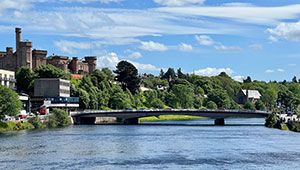
Oban is a bustling Victorian harbour town on the west coast of Scotland, set around a sheltered, near-circular bay in Argyll and Bute and framed by wooded hills and the island of Kerrera. Long known as the "Gateway to the Isles" for its busy CalMac ferry terminal, it is also celebrated as the "Seafood Capital of Scotland", and its crescent of grand seafront buildings, working fishing pier and constant coming-and-going of ferries give it an unmistakably maritime character.
Top things to do in Oban
- McCaig's Tower — this Colosseum-like stone folly, built by a local banker in the 1890s, crowns the hill above the town; the ten-minute climb up is rewarded with free access and panoramic views over the bay to Kerrera, Lismore and the Morvern hills.
- Oban Distillery — founded in 1794, this is one of Scotland's oldest working distilleries, squeezed between the main street and the cliff in the heart of town; tours explain the whisky-making process and finish with drams of the distinctive West Highland single malt.
- Dunollie Castle & Museum — a short walk north of the centre, the ruined MacDougall stronghold stands guard over the bay's entrance; a ticket also opens the 1745 House museum and the historic woodland grounds.
- Oban War & Peace Museum — a small, free museum near the North Pier telling the story of the town's maritime heritage and its important role during the Second World War.
- Ferries to Mull, Iona and Kerrera — from the terminal you can sail with CalMac to Mull (Craignure) and on to holy Iona, or take the short passenger ferry across to peaceful Kerrera; onward routes reach Colonsay, Coll, Tiree, Barra and South Uist.
- Dunstaffnage Castle — a few miles north, this 13th-century fortress on a rocky outcrop over the Firth of Lorn was once captured by Robert the Bruce and makes a rewarding half-day outing.
- Ganavan Sands — a sheltered sandy beach about 2.5km north of the harbour, with clear views across the Firth of Lorn; it is the start of a fine coastal walk to Dunstaffnage.
- Wildlife boat trips — operators run cruises from the harbour in search of seals, porpoises, dolphins, sea eagles and seabirds among the surrounding islands and sea lochs.
Getting to Oban
The most memorable approach is by rail. ScotRail runs direct trains on the celebrated West Highland Line from Glasgow Queen Street to Oban, a journey of around three hours through some of Scotland's finest scenery, with several services a day. Oban's station sits right beside the harbour, just a few minutes' walk from the ferry terminal, making onward island travel simple. By road, Oban is roughly a 2.5-hour drive from Glasgow, typically via the A82 along Loch Lomond then the A85 through Tyndrum and the Pass of Brander. Scottish Citylink coaches also serve the town from Glasgow. As the region's main ferry hub, Oban connects by CalMac to Mull, Lismore, Colonsay, Coll, Tiree, Barra and South Uist, so it works equally well as a destination in its own right or as a springboard to the Hebrides.
Best time to visit Oban
Late spring and summer are the most popular times, when the long daylight hours, calmer seas and full ferry timetables make island-hopping and boat trips easiest, and the seafood is at its best. The town is at its liveliest in summer: Oban Live, a major open-air music festival, draws big crowds in the warmer months, while West Highland Yachting Week fills the bay with sails around late July and early August, one of Scotland's largest yachting events. Autumn brings quieter streets, golden hillsides and good value, though ferry schedules begin to thin. Winter is atmospheric but wet and windy, with shorter days and reduced sailings, so it suits visitors after a cosy, off-season escape rather than island excursions. As on much of the west coast, weather is changeable year-round, so waterproofs are always sensible.
Where to stay in Oban
The most sought-after addresses are along the seafront, particularly the Corran Esplanade, where a curve of grand Victorian villas and hotels look straight out over the bay towards the isles. Well-known seafront options include the Perle Oban and the Oban Bay Hotel, both close to the water. The town centre, clustered around the harbour and George Street, is the most convenient base for the train station, ferry terminal, shops and restaurants. Beyond the hotels there is a wide choice of guesthouses and traditional bed-and-breakfasts, self-catering apartments and cottages, and a hostel or two, catering to everyone from island-hoppers to touring families. In peak summer and during major events, accommodation books up well ahead, so it pays to reserve early.
Food and drink in Oban
Oban wears its title of Seafood Capital of Scotland with pride, and eating here is a highlight in itself. The famous Oban Seafood Hut — the little green shack on the Railway Pier, established in 1990 by a local fisherman — serves superb, affordable fresh shellfish to go, from dressed crab and langoustines to oysters and mussels, and is easily spotted by its queue. For a sit-down meal with a view, Ee-Usk is a landmark glass-fronted seafood restaurant on the North Pier, alongside its Italian sister restaurant Piazza. Across the town's cafés and restaurants you will find local mussels, langoustines, scallops, oysters and hand-dived shellfish landed on the very piers you can watch from your table, plus traditional fish and chips. Round off a meal with a dram of Oban single malt from the town-centre distillery, the perfect west-coast pairing. Oban makes a natural base for exploring more of Scotland and its islands.