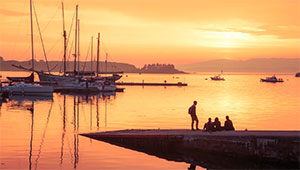
Set on the banks of the fast-flowing River Ness where it empties into the Moray Firth, Inverness is the undisputed capital of the Scottish Highlands and one of Britain’s most northerly cities. Compact, walkable and framed by hills, it makes an ideal base for exploring the region: within easy reach lie the brooding waters of Loch Ness, the battlefield of Culloden, the Cairngorms National Park and the wild coastlines of the far north. The city itself blends red-sandstone Victorian architecture, a lively pedestrian centre and a riverside setting that turns golden on long summer evenings. For more Scottish destinations, see our Scotland guide.
Top things to do in Inverness
- Loch Ness & Urquhart Castle cruises — The area’s star draw. Boat trips run from Inverness and nearby Dochgarroch down the loch, most calling at the dramatic ruins of Urquhart Castle, perched above the water and offering some of the best views of Scotland’s most famous stretch of freshwater.
- Inverness Castle & viewpoint — The pink-hued Victorian castle stands on a mound above the river. Long used as a courthouse, it has been redeveloped as a Highland visitor attraction, and the surrounding grounds and tower give sweeping views over the city and river.
- Culloden Battlefield — A few miles east lies the moor where the 1746 Battle of Culloden ended the Jacobite Rising. The excellent National Trust for Scotland visitor centre and the atmospheric memorial cairn and clan graves make it a moving, essential visit.
- Clava Cairns — Close to Culloden, this remarkably preserved Bronze Age cemetery complex features passage graves, ring cairns and standing stones dating back around 4,000 years, set among ancient trees.
- The River Ness & Ness Islands walk — A gentle, much-loved stroll leads from the city centre along the river to the Ness Islands, wooded islets linked by elegant Victorian suspension bridges — perfect for an easy afternoon amble.
- Inverness Cathedral — The twin-towered St Andrew’s Cathedral sits on the west bank of the river, a fine 19th-century Gothic building and a peaceful stop on any riverside walk.
- The Victorian Market — A restored indoor market in the heart of town, home to independent shops, boutiques and stalls, plus a revamped food hall for a bite between browsing.
- Leakey’s Bookshop — Housed in a former Gaelic church, Scotland’s largest second-hand bookshop is stacked with tens of thousands of volumes around a wood-burning stove — a browser’s paradise.
- Day trips: the North Coast 500 & Cairngorms — Inverness is the traditional start and finish of the North Coast 500 touring route and a gateway to the Cairngorms National Park, making it the launchpad for unforgettable Highland driving.
Getting to Inverness
Inverness is far better connected than its Highland setting suggests. By rail, the station is a terminus for four lines. The Highland Main Line links the city to Perth, Edinburgh and Glasgow, with journeys to either central-belt city taking around three and a half hours; most services are run by ScotRail. LNER’s Highland Chieftain runs through to London, and the Caledonian Sleeper offers an overnight service to London Euston every night except Saturdays. Two of Britain’s great scenic railways also start here: the Far North Line to Thurso and Wick, and the Kyle Line to Kyle of Lochalsh (near Skye), a spectacular run of roughly two and three-quarter hours. By road, the A9 is the main artery south to Perth and the central belt, while the A96 heads east to Aberdeen. Inverness Airport, about eight miles east at Dalcross, handles UK and some European flights. Long-distance coach services also link the city to Glasgow, Edinburgh and beyond.
Best time to visit Inverness
Spring (April–May) brings fresh greenery, blossom and quieter roads — a fine time for touring before the crowds. Summer (June–August) is peak season, with famously long daylight hours that stretch late into the evening, warm-ish weather and every attraction and cruise in full swing; it is also the best base period for Highland touring, though be prepared for midges — the tiny biting flies most active on still, damp days near water. Autumn (September–October) is arguably the most beautiful season, as the surrounding hills, glens and the Ness Islands turn gold and russet, with crisp light and thinning crowds. Winter is cold, dark and atmospheric, with a festive city centre and Christmas markets, snow often dusting the nearby Cairngorms, and Inverness making a cosy base for those chasing the northern lights or a Highland Hogmanay.
Where to stay in Inverness
The city centre is the most convenient base, putting the station, shops, restaurants and the castle within a short walk; here you’ll find everything from budget guesthouses to smart hotels. The riverside, along both banks of the Ness, is prized for its views and its easy access to the Ness Islands walk, with a mix of townhouse B&Bs and hotels. The leafy Crown district, on the hill above the centre, is a quiet Victorian residential area popular for its traditional guesthouses and bed-and-breakfasts. Beyond the city, self-catering cottages, country hotels and lodges around Loch Ness and the Moray Firth suit those planning to tour more widely.
Food and drink in Inverness
Inverness makes the most of superb Highland produce. Look for local venison, wild and farmed salmon, Aberdeen Angus beef and fresh seafood from the surrounding coasts on menus across the city, from riverside bistros to relaxed pubs. The revamped food hall in the Victorian Market is a good spot to graze on street food and local specialities under one roof, while independent cafés and restaurants around Church Street and the river cater for every budget. Whisky lovers are especially well placed: Inverness sits on the doorstep of Speyside, the country’s most celebrated malt-whisky region, so a dram of local single malt — or a distillery day trip — is easily arranged. Craft beer, Highland gin and cosy traditional bars with live folk music round out a genuinely characterful food-and-drink scene.